
What should a builder website have?
Good builder website design works differently to most trade sites. Nobody books a new home or a major renovation off one visit. They come back five or ten times over a few months, show their partner, compare you with two or three other builders, and only then fill in the form. Your site has to earn trust over all of those visits.
The builder websites that do that well have a few things in common:
- Real projects, with detail. Not just a photo grid, but the suburb, the type of build, the size and how long it took.
- Your licence or registration number on every page, along with your insurances and how long you've been trading.
- Your process, step by step, from first meeting through preconstruction, contract, build and handover.
- Who you build for, like knockdown rebuilds, custom homes, extensions or renovations, and the areas you work in.
- Honest price guidance. A "projects typically start from" figure filters out people who were never going to be a fit.
- One clear next step on every page, so a ready client knows exactly what to do.
How much does a website for a builder cost?
A builder website from Source Digital starts at $1,750 + GST for a single page, but most builders are better on the $3,250 + GST business site, with room for project pages, your process and a page per type of build. Every price is fixed and quoted in writing before work starts.
Hosting runs about $10 to $50 a month depending on the platform. If you want features beyond a normal website, like a client portal or a quote tool, that's a custom build quoted on request. Ongoing support and changes start from $200 a month if you'd rather not update the site yourself.
One page for a single service in a tight area.
- One page, mobile first
- Tap to call and a quote form
- Google Business Profile linked
- Basic SEO and tracking
Most tradies and service businesses.
- 5 to 8 pages, one per service
- Written for local and AI search
- Your real photos, no stock
- Schema, analytics and Search Console
Shopify or a custom storefront.
- Store design and setup
- Products, payments and shipping
- SEO for every product page
- Launch support
Booking systems, portals and web apps.
- Hand-coded for speed
- Integrations and custom logic
- CRM and automation built in
- Scoped in writing first
Prices exclude GST. Hosting is separate, about $10 to $50 a month depending on platform. Ongoing changes and support from $200 a month.
Which pages does a builder website need?
Good builder website design usually means six to eight pages, built around what a client wants to check before they get in touch. Here's a typical layout:
| Page | What it does | What to put on it |
|---|---|---|
| Home | Says what you build, where, and for whom | Your best project, your licence, one clear call to action |
| Projects | Proves you've done it before | A page per project: suburb, build type, size, photos |
| A page per build type | Matches searches like "custom home builder" or "knockdown rebuild" | Who it suits, typical timeframes, price guidance |
| Process | Takes the fear out of a big decision | Each stage from first meeting to handover, including preconstruction |
| About | Shows who they'll actually be dealing with | You, your team, years trading, licence and insurance |
| FAQs | Answers the questions clients ask on every first call | Costs, timeframes, variations, finance, council approvals |
| Contact | Turns interest into a meeting | A short form asking about block, budget and timing |
How should builders show their projects online?
In builder website design, give each project its own page instead of dumping everything into one gallery. A project page can rank in Google for searches like "double storey builder" in your area, and it gives a serious client the detail they want before they call.
For each project, include:
- The suburb and the type of build.
- The size, the timeframe and any challenge you solved, like a sloping block or a tight lot.
- A mix of finished photos and a few progress shots, because clients like seeing how you build, not just the result.
- A short quote from the client if they're happy to give one.
Use your own photos. Stock images of homes you didn't build are easy to spot, and in an industry built on trust, they do real damage.
Should a builder website sell paid preconstruction?
If you charge for preconstruction, yes, the website should explain and sell it. A paid design and costing stage filters out tyre kickers and commits serious clients early, but only if they understand what they're paying for before the first meeting.
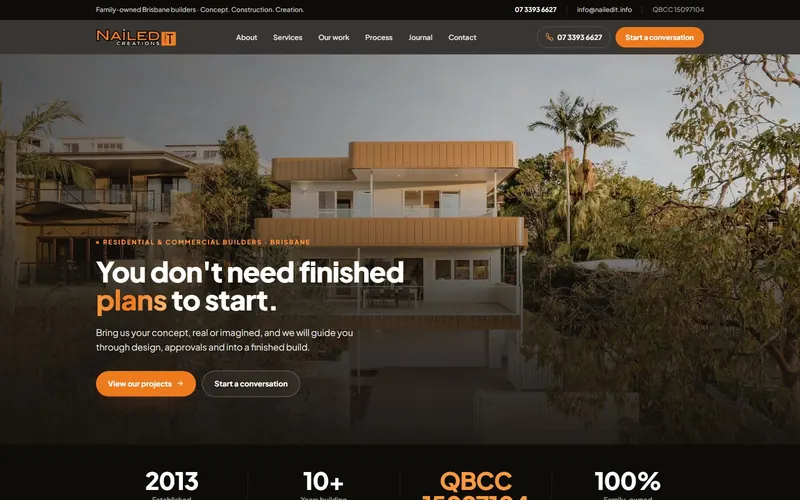
That's how we rebuilt the site for Nailed It Creations, a QBCC licensed family custom home builder in Brisbane, trading since 2013. The whole site is built around his paid preconstruction process, with one call to action across every page and 87 questions answered in FAQ schema so Google and AI tools can read them. Enquiries go straight into his own CRM on Omega CS. It launched in September 2026.
If you don't charge for preconstruction, the same idea still applies. Explain the first step clearly, say what happens at the first meeting, and make it the one thing every page asks people to do.
How can builders follow up enquiries faster?
Answer every new enquiry within minutes, even when you're on site. MIT and InsideSales found leads contacted within 5 minutes were 21 times more likely to qualify than leads contacted at 30 minutes, and a building client comparing three builders often goes with whoever responded first and sounded organised.
Omega CS, our CRM, texts every new web form, Facebook and Instagram lead back in seconds from your own Australian mobile number. It asks about the block, budget and timing, follows up quotes until you get a yes or no, texts back missed calls and books meetings into your Google Calendar. A Perth renovation builder using it reported "Over $580k in sales and $1.2M in pipeline in his first 30 days." It's from $350 + GST a week with $0 setup.
How we build a builder website
- A free 15 minute call. What you build, where, the size of jobs you want and how you take enquiries now.
- A fixed price quote. Pages, features and timeline in writing, usually the same day.
- We build it. I check what clients in your area search, write the pages with you and lay out your projects properly.
- You review it. You click through it on your phone and change anything that doesn't sound like you.
- It goes live. Google Business Profile linked, tracking set up and every enquiry going where you'll see it.
Most builder website design projects go live in 2 to 4 weeks. The usual hold up is gathering project photos and details, so start pulling those together early. If you're also after more leads straight away, a landing page for Google Ads can run alongside the main site. For other trades, see our page on websites for tradies.