
How do you know your website needs a redesign?
Your website needs a redesign when it's costing you enquiries, not just when it looks dated. An old look is the least important sign. These are the ones that matter:
| Sign | Why it matters |
|---|---|
| It's slow on a phone | Mobile visitors leave before it loads and call the next business |
| Enquiries have dropped but your work hasn't changed | The site may have slipped in Google or stopped answering what people now search |
| You can't update it, or nobody knows how | Prices, services and photos go stale and customers notice |
| One page tries to cover every service | Google can't match you to specific searches |
| It's split across two platforms | A services site here, a shop there, two logins and two bills |
| It doesn't match what you sell now | Your best paid work isn't on the site, so nobody asks for it |
If two or more of those sound familiar, a website redesign is usually a better use of money than more ad spend pointed at the old site.
How much does a website redesign cost?
A website redesign is quoted at a fixed price from the same price list as a new site: $1,750 for a single page, $3,250 for a 5 to 8 page business site and from $4,500 for an online store, all ex GST.
WordPress redesigns start from $2,500, and custom WordPress builds with plugins and integrations run $5,000 to $12,000. Hosting stays roughly $10 to $50 a month depending on the platform.
What moves the price is scope: how many pages, whether products need moving across, and whether you're changing platforms. You get the number in writing before anything starts, and that's the number you pay.
One page for a single service in a tight area.
- One page, mobile first
- Tap to call and a quote form
- Google Business Profile linked
- Basic SEO and tracking
Most tradies and service businesses.
- 5 to 8 pages, one per service
- Written for local and AI search
- Your real photos, no stock
- Schema, analytics and Search Console
Shopify or a custom storefront.
- Store design and setup
- Products, payments and shipping
- SEO for every product page
- Launch support
Booking systems, portals and web apps.
- Hand-coded for speed
- Integrations and custom logic
- CRM and automation built in
- Scoped in writing first
Prices exclude GST. Hosting is separate, about $10 to $50 a month depending on platform. Ongoing changes and support from $200 a month.
Will a website redesign hurt my Google rankings?
It shouldn't, if the old URLs are handled properly. Most rankings lost in a redesign are lost because pages moved and nobody told Google.
Before we change anything, we list every page on your current site that gets traffic or has links pointing to it. Then:
- Pages that work keep their URL wherever possible, so nothing changes for Google.
- Pages that move get a 301 redirect from the old address to the new one, which carries most of the ranking across.
- Content that ranks stays, tidied up to read better but still answering the same search.
- Titles, descriptions and structured data are carried over or improved, never dropped.
- The new sitemap goes to Google Search Console on launch day so the changes get picked up quickly.
A small wobble for a few weeks after launch is normal while Google recrawls the site. A drop that lasts longer usually means something was missed, which is why we keep checking after launch. If you want to grow rankings rather than just protect them, pair the redesign with ongoing SEO.
What does a redesign keep and what does it change?
A good redesign keeps everything that's earning you money and changes everything that's getting in the way.
What we keep: your domain, the URLs that rank, the content Google already trusts, your reviews and your brand if it still fits.
What we change: the layout, speed, mobile experience, calls to action, photos and the structure of your service pages. Often we add pages too, one per service you want more of, because that's how a site starts showing up for more searches.
Sometimes the platform changes as well. If you're moving from Wix, WooCommerce or another platform to Shopify, our Shopify migration page covers what moves across and how.
Should I redesign on my current platform or move to a new one?
Stay on your current platform if it does what you need and the problem is the design. Move if the platform itself is the problem: it's slow, it can't do something you need, or it costs too much to run.
Common reasons people move:
- Wix to hand-coded HTML for speed and full control of how each page ranks.
- Two platforms into one, like a services site and a separate shop merged into a single Shopify site.
- WordPress to Squarespace for owners tired of plugin updates who want to edit the site themselves.
We build on Squarespace, Shopify, WordPress, WooCommerce and custom code, so the recommendation comes from what suits your business. If you're weighing up a hand-coded rebuild, read about our custom website development.
How the redesign works
- Audit your current site. I look at which pages get traffic, what ranks, what's slow and where enquiries drop off.
- Fixed price quote. What we'll keep, what we'll change, the platform and the timeline, in writing.
- Plan the URLs. Every old page mapped to its new home before design starts.
- Design and build on a private link while your current site stays live.
- You review it. Change what you want changed before anything goes public.
- Launch and check. Redirects tested, sitemap submitted, tracking live and rankings watched in the weeks after.
Most redesigns go live in 2 to 4 weeks, and Shopify rebuilds usually take 2 to 3. Your old site stays up the whole time, so there's no gap where customers can't find you.
Website redesigns we've done
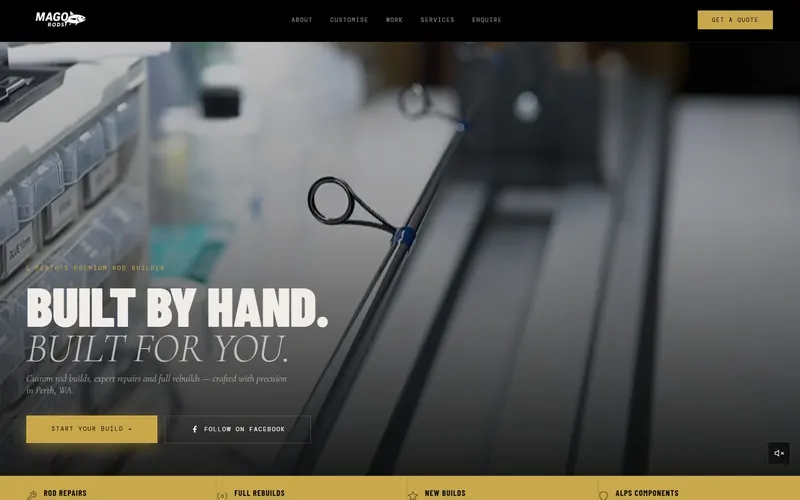
- Mago Rods moved off a generic Wix template to a hand-coded HTML/CSS site. 9 pages in 2.5 weeks, with a 100 Lighthouse performance score.
- Malaya Swimwear got a Shopify rebuild with a bespoke theme. A 3 week build with 21 products launched.
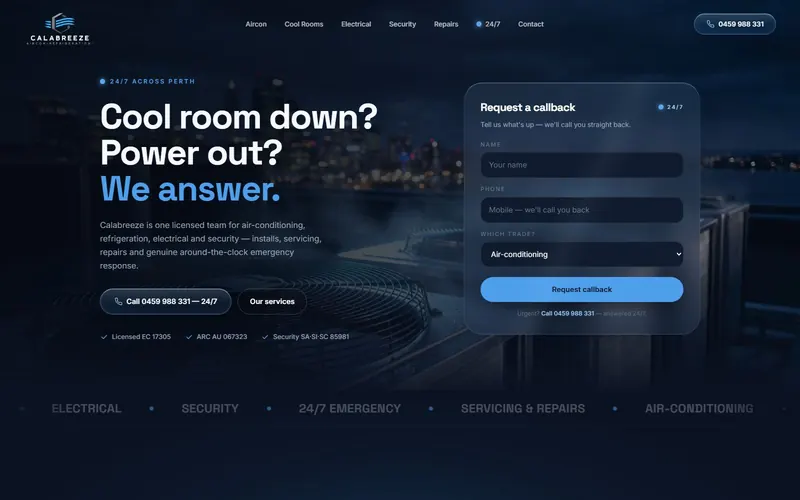
- Vlosity Motorsport had a Wix services site and a separate Shopify store. We merged them into one Shopify site with service bookings, with 28 products migrated and 3 service categories set up.
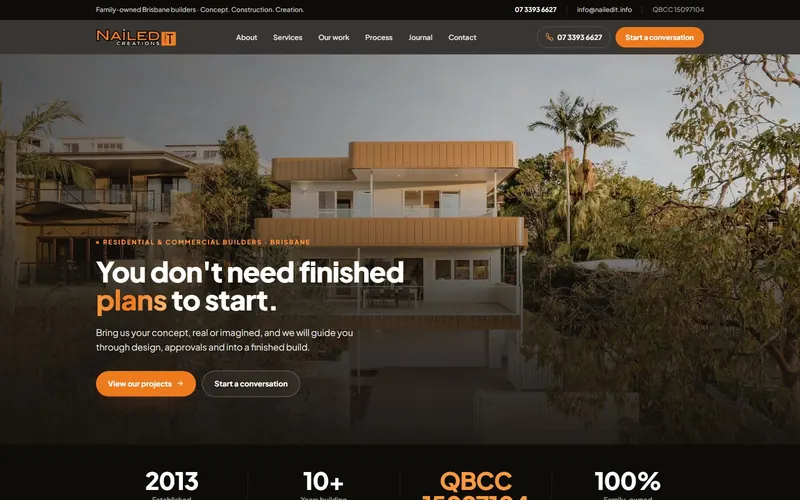
- Nailed It Creations, a Brisbane custom home builder, had his site rebuilt around his paid preconstruction process, with one call to action site-wide, 87 questions in FAQ schema and his own CRM on Omega CS.
Each one kept what was working and fixed what wasn't. None of them started from a blank page with Google.