
What should a law firm website have?
Law firm website design comes down to one thing: when someone searches for help with a legal problem, your site should make it obvious within seconds that you handle that matter, where you are and how to start. Everything else is detail.
People looking for a lawyer are usually stressed and often reading on a phone. They want to know three things before they call: do you do this kind of matter, have you done it before, and what happens if I get in touch. Every firm site we build is set up around those questions:
- A page for each practice area, such as family law, wills and estates, conveyancing, employment or criminal law, so Google can match a search to the right page.
- Profiles for each lawyer with the matters they handle, written in plain English.
- A clear first step, whether that's a free first call, a fixed fee initial consult or a form.
- How you charge, even if it's just "fixed fees for most conveyancing, hourly for disputes". Vague fee pages put people off.
- Office locations and hours, linked to your Google Business Profile.
- Fast loading on mobile data, because a slow site loses the enquiry to the next firm.
How much does law firm website design cost?
Law firm website design with Source Digital costs $3,250 + GST for a 5 to 8 page site with a page per practice area. A single page site is $1,750 + GST, which suits a sole practitioner with one main practice area. Every price is fixed and in writing before work starts.
Firms with a lot of practice areas, several offices or a client portal need more than 8 pages, so those are quoted after a short call. Hosting runs about $10 to $50 a month depending on the platform, and website support and changes are from $200 a month if you'd rather not touch it yourself. There are no lock-in contracts.
If you mainly want enquiries from ads, a single practice area landing page starts from $950 + GST.
One page for a single service in a tight area.
- One page, mobile first
- Tap to call and a quote form
- Google Business Profile linked
- Basic SEO and tracking
Most tradies and service businesses.
- 5 to 8 pages, one per service
- Written for local and AI search
- Your real photos, no stock
- Schema, analytics and Search Console
Shopify or a custom storefront.
- Store design and setup
- Products, payments and shipping
- SEO for every product page
- Launch support
Booking systems, portals and web apps.
- Hand-coded for speed
- Integrations and custom logic
- CRM and automation built in
- Scoped in writing first
Prices exclude GST. Hosting is separate, about $10 to $50 a month depending on platform. Ongoing changes and support from $200 a month.
How should a law firm intake form work?
A good intake form collects enough to route and conflict check the enquiry, and no more. Asking people to type out their whole situation into a web form creates risk for you and for them, and long forms get abandoned.
| Field | Why it's there | Keep in mind |
|---|---|---|
| Matter type (dropdown) | Sends it to the right lawyer | Match it to your practice area pages |
| Other party's name | Lets you run a conflict check before you call back | Make it optional, explain why you ask |
| Any deadline or court date | Flags urgent matters | A simple date field, not free text |
| Best number and time to call | You call when they can talk privately | Ask if it's safe to leave a message |
| A short note (optional) | Context for the first call | Tell them not to include confidential detail yet |
Two more things matter. The form should go to a monitored inbox or system, not a shared address nobody checks. And many firms add a short note that sending a form doesn't create a lawyer and client relationship. Get the exact wording from your own practice management guidance or your insurer, not from your web designer.
What advertising rules apply to law firm websites?
Your website is advertising, so the legal profession's advertising rules apply to it, and they vary by state. This is general information as of November 2026, not legal advice. Check your state's current rules with your law society or legal services commissioner before launch.
- Misleading claims. Rule 36 of the Australian Solicitors' Conduct Rules says advertising must not be false, misleading, deceptive or offensive, or otherwise prohibited by law.
- The word specialist. The Law Society of NSW notes that "accredited specialist" may only be used by a solicitor accredited by the relevant professional association.
- Personal injury in Queensland. The Personal Injuries Proceedings Act 2002 restricts how personal injury services are advertised. The Legal Services Commission's guideline (published 16 March 2022) covers websites, search engine optimised results and paid search, and treats a site viewed in Queensland as published there. Some content may need to sit behind an access step, not open to every visitor.
- NSW personal injury. The Law Society of NSW says the old ban in the Legal Profession Regulation 2005 isn't in the Uniform Law, but the general conduct rules still apply.
What I do: build the site so this is easy to get right. Claims are kept factual, testimonials only go in if your rules allow them, and a principal signs off every page before it goes live.
Can a law firm website show up on Google and in AI answers?
Yes. Law firm website design that ranks starts with giving each practice area its own page that answers the questions people actually ask, in plain words. That's what Google ranks for local legal searches and what AI tools like ChatGPT and Google's AI answers quote.
On each practice area page we answer the real questions: what the process looks like, roughly how long it takes, what it costs to start and what to bring to the first meeting. We add structured data so search engines can read your firm, lawyers, offices and practice areas. Our AEO work goes deeper if you want to be the firm AI assistants name.
Search takes time. A new site with good structure usually starts picking up local searches within 2 to 3 months. Legal clicks on Google Ads are expensive, often $12 to $30 a click, so if you run ads, point each one at the matching practice area page, not your home page. In Queensland, remember the personal injury rules above cover paid search too.
What makes people trust a law firm website?
Real people, real detail and a fast, tidy site. Stock photos of a gavel and a handshake tell a visitor nothing, and they're the most common mistake I see in law firm web design.
- Photos of your actual team and office. People want to see who they'll be talking to.
- Plain English. Write for the client, not for other lawyers.
- Memberships and accreditations you actually hold, stated accurately.
- Speed. Our recent builds have scored 94 to 100 for Lighthouse performance in testing, and a firm site should be no different.
Websites we've built that show the approach
We haven't published a law firm case study yet, so here's honest proof of the parts that matter for a firm site:
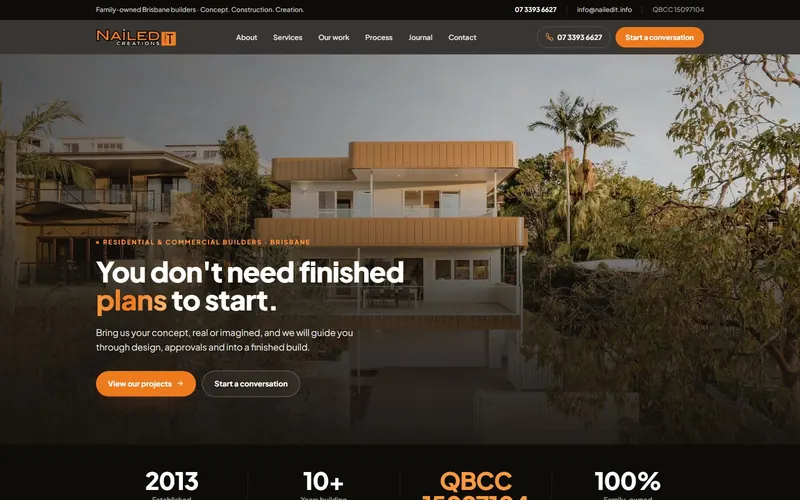
- Nailed It Creations: a Brisbane custom home builder whose site was rebuilt around a paid first step, his preconstruction process, with one call to action site-wide and 87 questions in FAQ schema across 19 pages. The same idea works for a fixed fee initial consult.
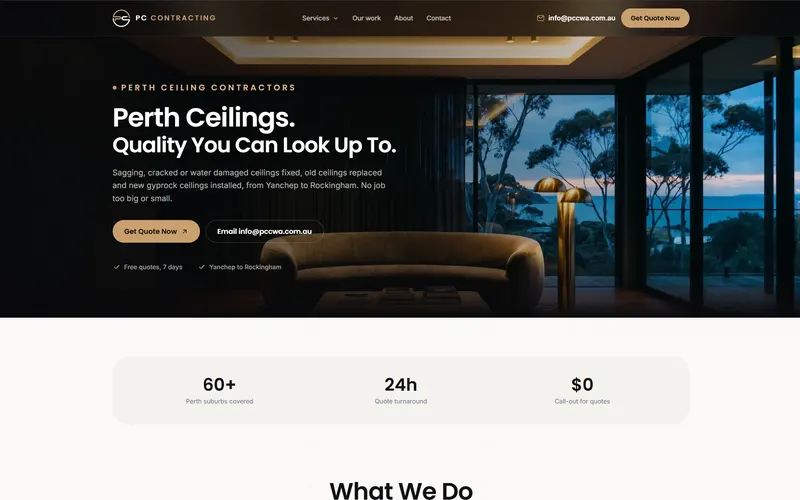
- Perth Ceiling Contracting: a 12 page site with every page mapped to a real search, prices published, tracking on every enquiry and 98 to 99 Lighthouse performance in testing.
How a law firm website build works
- A free 15 minute call. Your practice areas, the matters you want more of and how you take on new clients.
- A fixed price quote. Pages, features and timeline in writing, usually the same day.
- We build it. I check what people search for each practice area, draft the pages and set up the intake form.
- You review and sign off. A principal checks every page against your advertising rules before launch.
- It goes live. Google Business Profile linked, tracking set up and every enquiry going where someone will see it.
Most law firm website design projects go live in 2 to 4 weeks. The usual hold up is sign off and team photos, so book the photographer early.